
Under MTD IT, it is the practice’s responsibility to assess each client and decide the most appropriate digital record-keeping solution.
Use the decision flow below to consistently allocate clients to the right Capium setup based on complexity, behaviour, and risk — not preference alone.
Step 1: Assess the Client’s Current Record-Keeping Method
* Client currently maintains records in spreadsheets
➡️ Go to Step 2A
* Client already uses (or is capable of using) bookkeeping software
➡️ Go to Step 2B
Step 2A: Spreadsheet-Based Clients
Is the client’s business low complexity and suitable for minimal digital change?
YES
✅ Assign: MTD IT Bridging Solution
Why the practice should choose this
Lowest implementation effort
Maintains existing workflows
Fully compliant with MTD IT digital link requirements
Reduces client friction and resistance
Typical characteristics
Simple sole trader
Low transaction volumes
Limited business categories
➡️ Decision complete — Bridging is the appropriate solution.
NO – the client requires more structure or oversight
➡️ Move to Step 2B
Step 2B: Clients Suitable for Digital Bookkeeping
Should the practice retain control of quarterly updates and submissions?
YES
✅ Assign: Capium Cloud Bookkeeping
Why the practice should choose this
Clean, structured digital records
Optional bank feeds improve accuracy
Client involvement without full responsibility
Practice controls compliance and submissions
Typical characteristics
Single business bank account
Moderate transaction volumes
Practice-led compliance model
➡️ Decision complete — Cloud Bookkeeping is the correct solution.
NO – the client can manage their own records reliably
➡️ Move to Step 3
Step 3: Automation & Client-Led Record Keeping
Would automation materially reduce the practice’s workload for this client?
YES
✅ Assign: Capium 365
Why the practice should choose this
Automated categorisation and reconciliation
Client uploads data in real time
Reduces manual processing and review time
Scales efficiently for high-volume clients
Typical characteristics
Multiple income sources
High transaction volumes
Digitally confident and responsive
➡️ Decision complete — Capium 365 is the optimal solution.
NO
↩️ Default back to Cloud Bookkeeping for controlled oversight.
Practice-Level Summary
| Client Profile (Practice Assessment) | Assigned Solution |
|---|---|
| Low complexity, spreadsheet-based | MTD IT Bridging |
| Moderate complexity, practice-led | Cloud Bookkeeping |
| High complexity, automation-led | Capium 365 |
Key Guidance for Practices
✔️ The practice determines the solution
✔️ Client preference should be considered — but not drive compliance decisions
✔️ Different solutions across the client base are expected and recommended
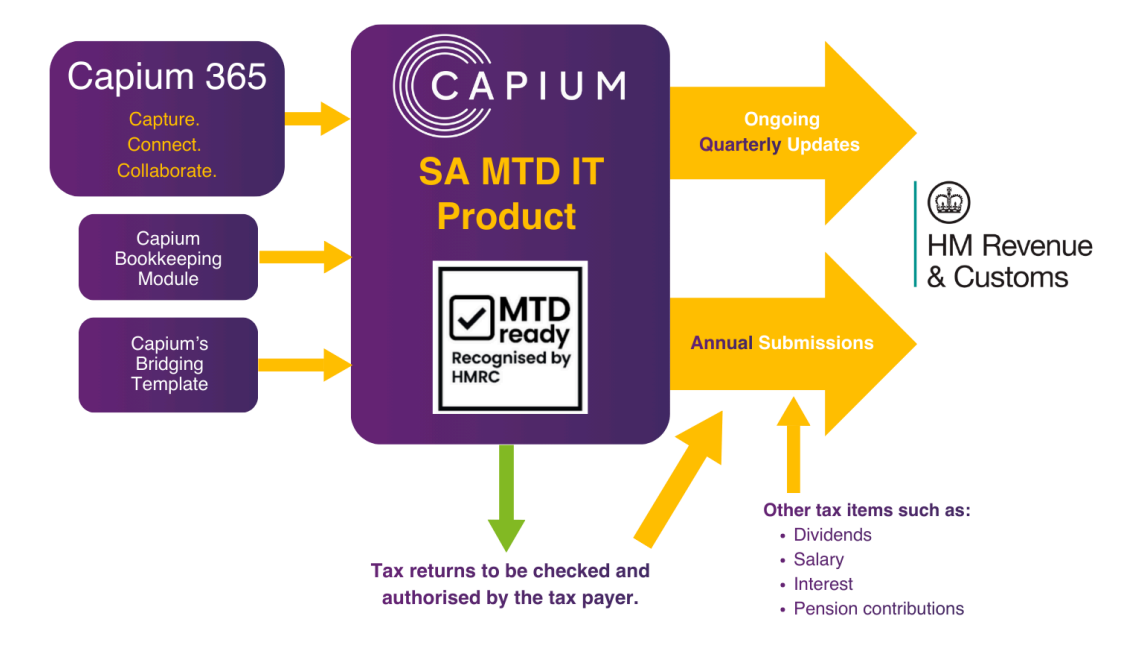
✔️ All routes feed into Capium’s MTD IT product for quarterly and annual submissions
Best Practice Tip ?
Segment your client list early using this flow:
Apply Bridging where change adds no value
Apply Cloud Bookkeeping where control is essential
Apply Capium 365 where automation saves time and cost
This ensures:
Faster onboarding
Lower support overhead
Consistent compliance
Predictable workflows